Roughly one in two car tests ends in a fail. Here is exactly how the test is marked — all 24 things you’re judged on — and the faults DVSA records most often, so you know where the marks are really lost.
Every test is scored on around two dozen competencies. Each mistake is recorded as one of three fault types — and only one of them gives you any room at all.
A mistake that wasn’t dangerous in the moment. You’re allowed a handful of these.
Not dangerous this time, but it could have caused danger in slightly different circumstances.
Real, immediate danger to you, the examiner, the public or property during the drive.
15 yellow = the driving faults you’re allowed. The red 16th is where a clean drive tips into a fail. A single serious or dangerous fault ends the test on its own, no matter how few minors you have. And if the examiner ever has to speak up or touch the controls to keep you safe — an “examiner took action” (ETA) — that’s logged as a serious or dangerous fault too.
Everything the examiner watches you do is marked on this single form: the DVSA DL25 driving test report. There’s no hidden scoring — this is the actual sheet, and this is what decides it.
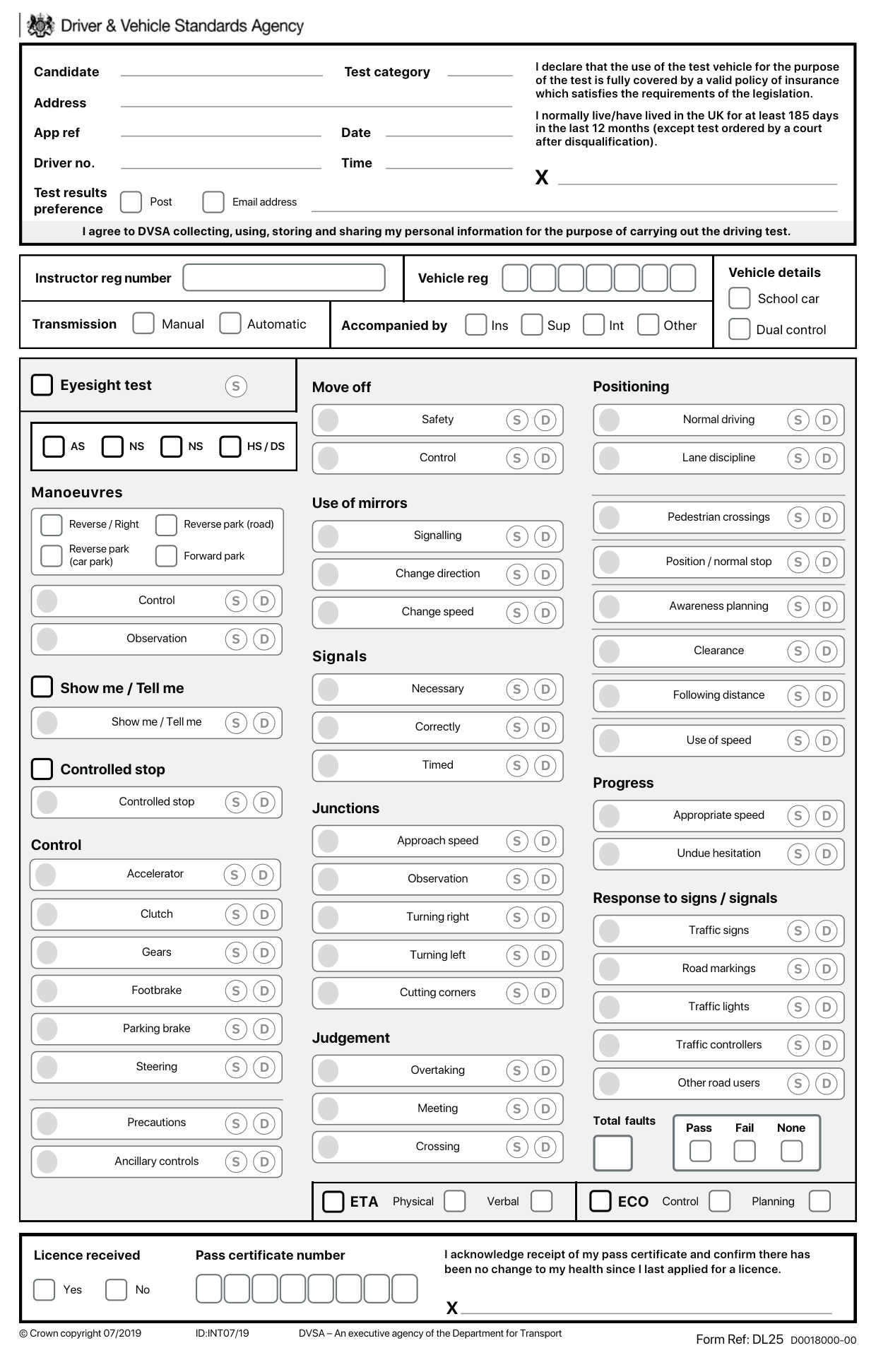
DL25 driving test report © Crown copyright 2019 (DVSA), reproduced under the Open Government Licence v3.0. The 24 competencies below are exactly the headings marked on this form.
Every car test is scored on these 24 competencies (the DL25 marking sheet), shaded by how often DVSA records a fault on each. Tap any one for what it means, where people slip up, and how to nail it.
These 24 competencies are GOV.UK’s official list for the car test — the same items marked on the DVSA DL25 test report form. (You’ll see instructors quote “27”; that counts sub-points and older multi-category forms — it isn’t a different scheme.) The shading and rank badges come from DVSA’s most-common-faults ranking (DRT121F, to March 2026): DVSA publishes the order faults are recorded in, not exact counts — so this shows ranking, never a percentage.
Zooming into those competencies, here are the exact fault types DVSA logs most in the latest data (April 2025 – March 2026), in rank order. Note some competencies appear more than once — “response to signs” shows up three times.
How to read this: bars show DVSA’s published rank order, not a percentage — anyone quoting “X% fail on mirrors” is estimating.
Observation at junctions has been the #1 fault every single year from 2007 to 2026, with mirrors-on-changing-direction #2 almost as long. If you fix one thing, make it looking properly — early and often — at junctions.
The national car practical pass rate has hovered in the high-40s for years, and just crossed 50% for the first time in 2025–26. It’s not getting dramatically easier — most people who fail are close.
Source: DVSA table DRT121E (tests conducted, passed, and pass rate by year). 2020–21 ran on a fraction of the usual test volume during COVID closures.
You pass with no more than 15 driving faults (“minors”) and no serious or dangerous faults. The 16th driving fault, or any single serious or dangerous fault, is a fail.
Observation at junctions — not looking properly before emerging or turning. It’s been the top recorded fault every year in DVSA data from 2007 to 2026, ahead of mirrors when changing direction.
A serious fault is potentially dangerous; a dangerous fault involves actual danger to you, the examiner, the public or property. Both fail the test immediately. If the examiner has to speak or take the controls to avoid an incident, that’s recorded as “examiner took action” (ETA) and counts as a major.
No — the test is identical. But waiting months for a first date, then months again to retake, is the real cost of failing. Catching a cancellation lets you sit your test (or retake) far sooner. That’s what our free alerts are for.
We watch DVSA for cancellations and alert you the instant an earlier slot drops at your centre. No fee, no booking on your behalf — you grab it yourself on GOV.UK.
🔔 Turn on free cancellation alertsPass rates, fault rankings and zero-fault figures contain public sector information from the Driver & Vehicle Standards Agency (DVSA), licensed under the Open Government Licence v3.0. Marking rules from GOV.UK — understanding your driving test result. Fault data: DVSA table DRT121F; pass-rate data: DRT121E (to March 2026). DVSA publishes fault rankings, not per-fault counts.